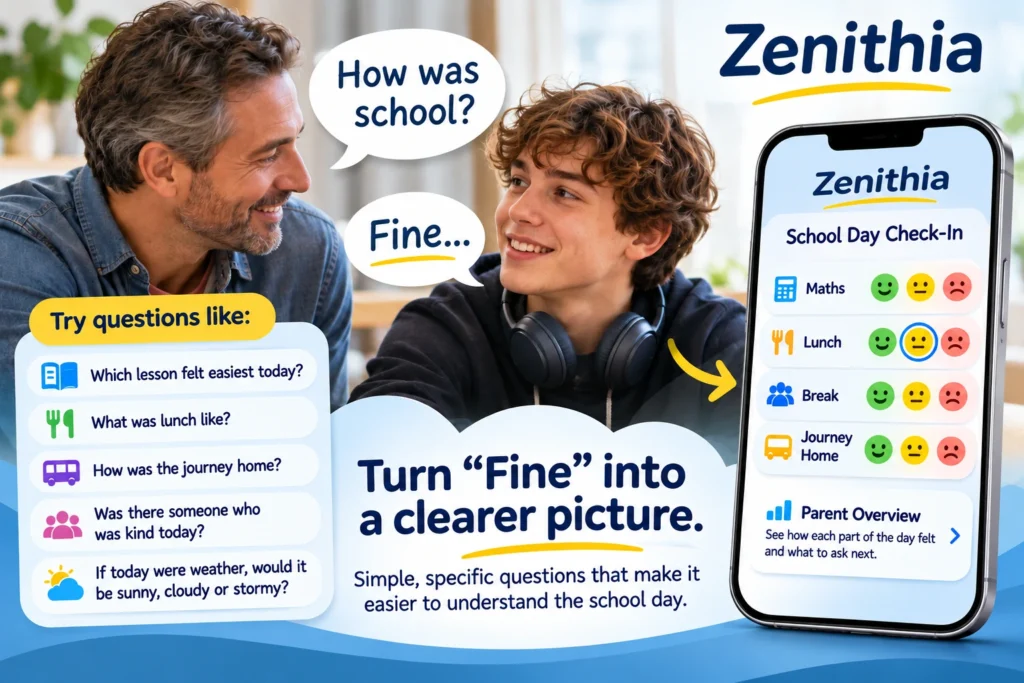
When the answer to “How was school?” is always “fine,” “good” or “I don’t know,” the problem is rarely the child or teenager. The question is simply too big to answer. A better question is smaller, more specific and easier to answer.
This list offers questions to try, grouped by part of the day, along with a few ways to make them easier to answer. None of them needs to be used all at once. One question a day is plenty.
Four ideas before the questions
- Ask about one part of the day. A single lesson, lunch or the journey is easier to describe than a whole day.
- Offer choices. “Calm, tricky or hard?” takes less effort than an open question.
- Pick the right moment. Right after school is often tiring. The car, a walk or bedtime can work better.
- Let them choose how to answer. Saying it, pointing, drawing, choosing a colour or giving a thumbs up or down all count.
Questions about the lessons
- Which lesson felt the easiest today?
- Which lesson felt the longest?
- Was there a lesson where something was hard to understand?
- Did anything surprising happen in class?
Questions about lunch and breaks
- What was lunch like today: quiet, noisy or somewhere in between?
- What happened at break time?
- Was there a place that felt calm?
Questions about the journey
- How was the journey to school this morning?
- How was the way home?
- Was anything different on the way?
Questions about people
- Was there someone who was kind today?
- Did anyone help today?
- Who was nearby at lunch?
Questions about feelings
- If today were weather, would it be sunny, cloudy or stormy?
- Pick a colour for today: green, yellow or red.
- What was the best part of the day, and what was the hardest part?
Questions about tomorrow
- Is there anything about tomorrow worth knowing more about?
- Is there something that would make tomorrow easier?
For teenagers
Teenagers often prefer less direct questions and more control over when to talk. A few approaches tend to work better:
- Talk side by side. A drive, a walk or a shared snack removes the pressure of eye contact.
- Keep the question light. “Anything worth knowing about today?” leaves room for “not really” without closing the conversation.
- Use text or a note if talking is hard. Some teenagers find writing easier than speaking.
- Respect privacy. Not everything needs to be shared. Feeling that the choice is theirs makes sharing more likely.
What to do with the answers
- Listen first. Resist the urge to fix the problem straight away. Often the most helpful response is “thank you for telling me.”
- Repeat their words. “So the afternoon lesson felt too long” shows the answer was heard.
- Look for patterns over a week. One hard lesson is a moment. The same lesson on four days is information worth acting on.
- Share with the school when it helps. A pattern is much easier for a teacher to respond to than a general worry.
- Seek support if distress continues. If a young person seems unhappy or anxious about school for a sustained period, a conversation with the teacher or a qualified professional is a sensible next step.
When words are hard
For some children and teenagers, even a small question takes more language than is available at the end of a school day. Visual choices can help: a set of faces, a colour scale, pictures of the day’s parts, or a simple “better, same or harder than usual.” Many families make these by hand, and they work well.
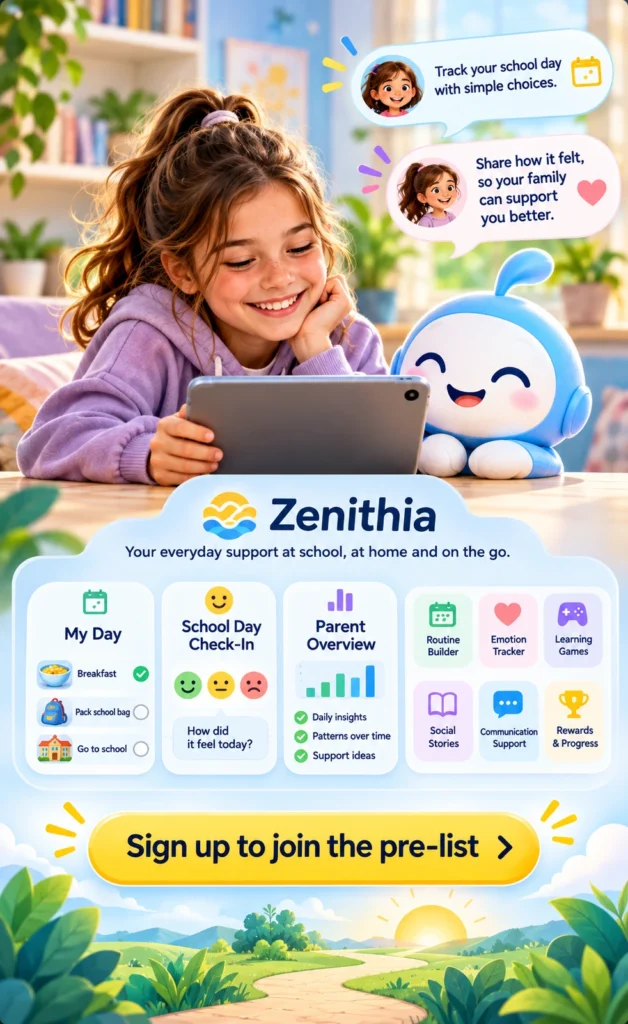
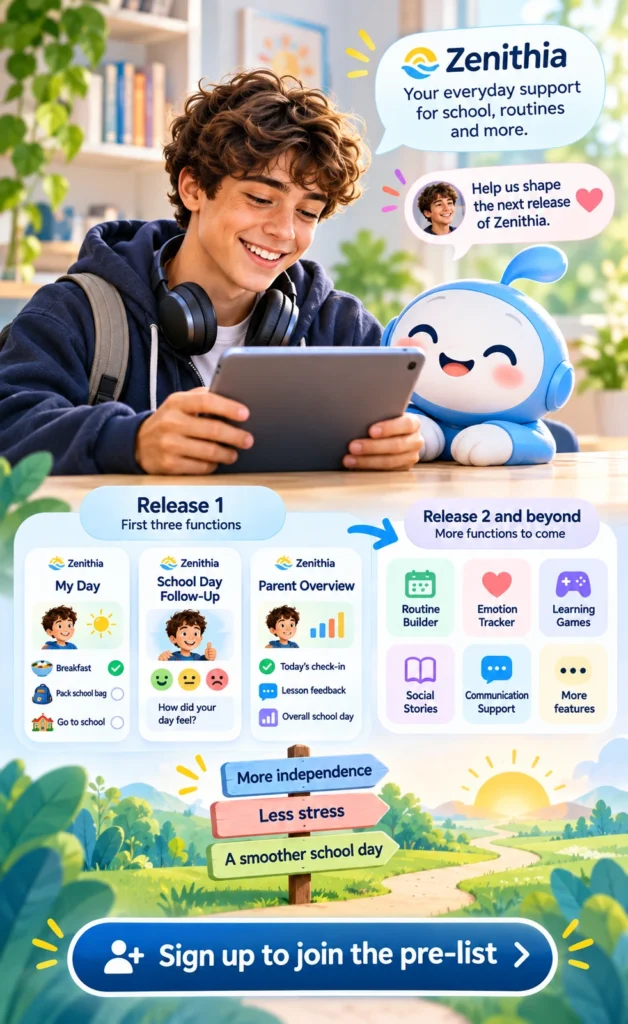
Zenithia, a mobile app for children and teenagers with autism, ADHD and other neurodevelopmental needs, builds the same idea into the school day. After each lesson, the journey and lunch, the child or teenager answers with simple visual choices. A parent sees how each part of the day went in the Parent Overview, which shows where the day got hard and what to ask next. The answers show how a part of the day felt to them. They are not a test, and the app is a family support tool, not a school monitoring system.
One question a day
There is no need to ask everything. One specific question, asked calmly and without pressure, tends to bring more than a general question asked every day. Over time, the answers show what school feels like from the inside.
Zenithia’s pre-release is planned for 28 November 2026. Joining the free early access list takes about a minute, and no payment is needed today. Join the free early access list