For many parents of children and teenagers with autism, ADHD and other neurodevelopmental needs, one question comes up again and again: how can a young person learn to handle the day-to-day things in life more on their own? Getting ready in the morning, knowing what comes next, coping with a change of plan and managing a school day can all take more support than parents are able to give every minute, especially when work and family life compete for time.
Independence is not an overnight change. It is built in small steps, and the steps look different for every person.
What independence really means
Independence does not mean doing everything alone. It means knowing what comes next, having a way to handle it, and knowing how to ask for help when it is needed. A teenager who checks a plan and asks for a break at the right moment is being independent, even if a parent set the plan up.
That definition helps because it removes an all-or-nothing idea. Every step toward managing a little more of the day counts.
Six principles that tend to help
- Start with one step. Choose a single part of the day, such as packing a school bag, and build from there. Trying to change everything at once usually overwhelms everyone.
- Make the steps visible. A picture or written list shows the order without anyone needing to say it. A visual plan can be checked as often as needed, without a reminder.
- Keep the order the same. A routine that happens in the same sequence each day becomes easier to predict, and predictability lowers the effort of each transition.
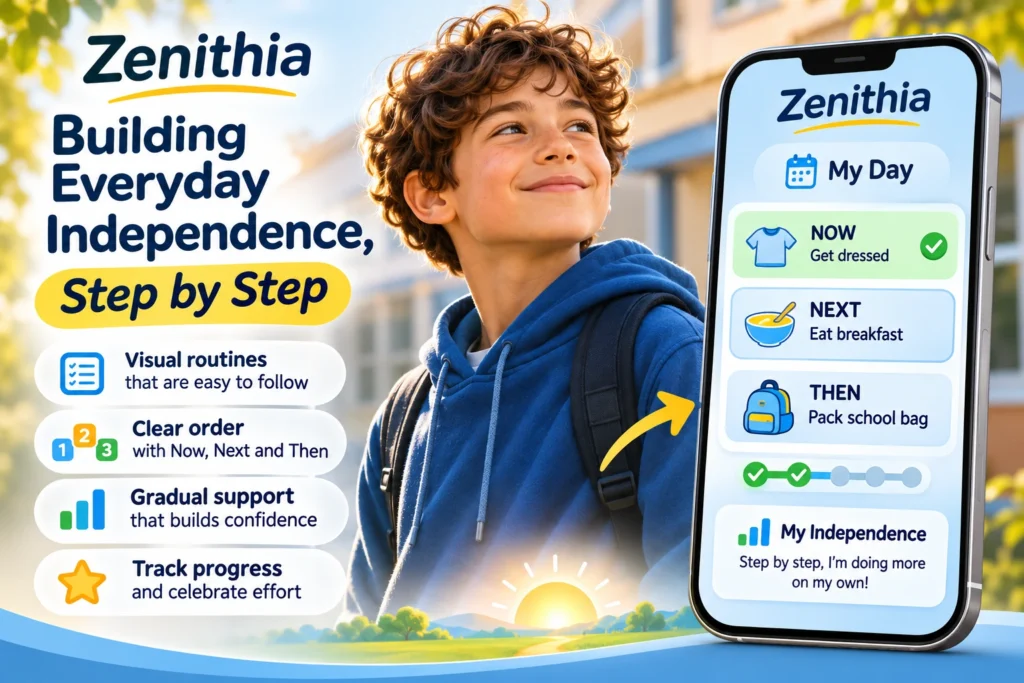
- Show what is happening now and what comes next. Knowing the current activity and the next one reduces surprises. Many families use “now, next, then” cards for this reason.
- Reduce help gradually. Begin with full support, then move to a hint, then a gesture, then a glance at the plan. The aim is for the plan, not the parent, to do the prompting over time.
- Notice effort, not only results. Acknowledging a step that was attempted keeps motivation up on days when it does not go perfectly.
An example: getting ready in the morning
Take a morning routine with six steps: get up, wash, get dressed, eat breakfast, brush teeth, pack the bag. A visual list shows each step in order.
In the first week, a parent might do the whole list alongside the young person, pointing at each step. In the second week, the parent might point only at the list and let the young person do each step. Later, the list alone may be enough for steps that have become easy, while steps that are still hard keep their extra support.
Progress is rarely even. One step may become independent within days, another may take months, and that is normal.
Teenagers: more say in the plan
Teenagers often want more control over how they are supported. Involving them in how the plan looks, which steps it contains and when they check in respects that. A plan that a teenager helped shape is far more likely to be used than one handed down.
When things do not go to plan
Change is often the hardest part. A different timetable, a missed bus or a substitute teacher can unsettle a well-practised routine. Telling the young person in advance, showing the change in the plan and acknowledging that it is harder than usual can help. Setbacks are part of the process, not a sign that it is failing.
The parent’s role: set up, then step back
Parents usually do the setting up: choosing the steps, their order and the right level of help. After that, the role shifts from doing to watching and adjusting. Looking at how the day went, which steps were smooth and which were hard, shows where to add support and where to step back.
Where a tool can help
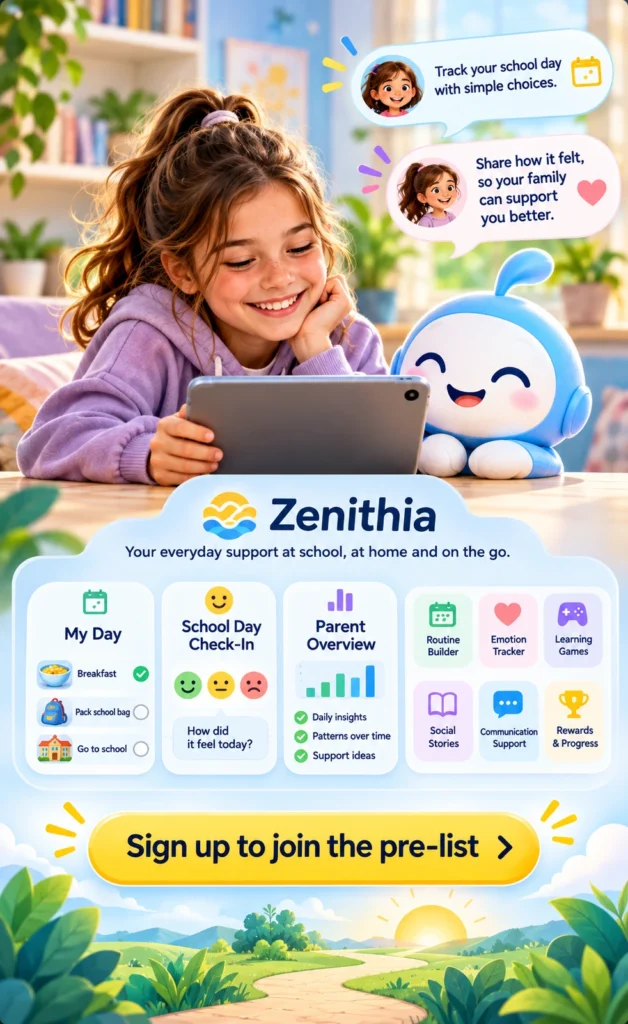
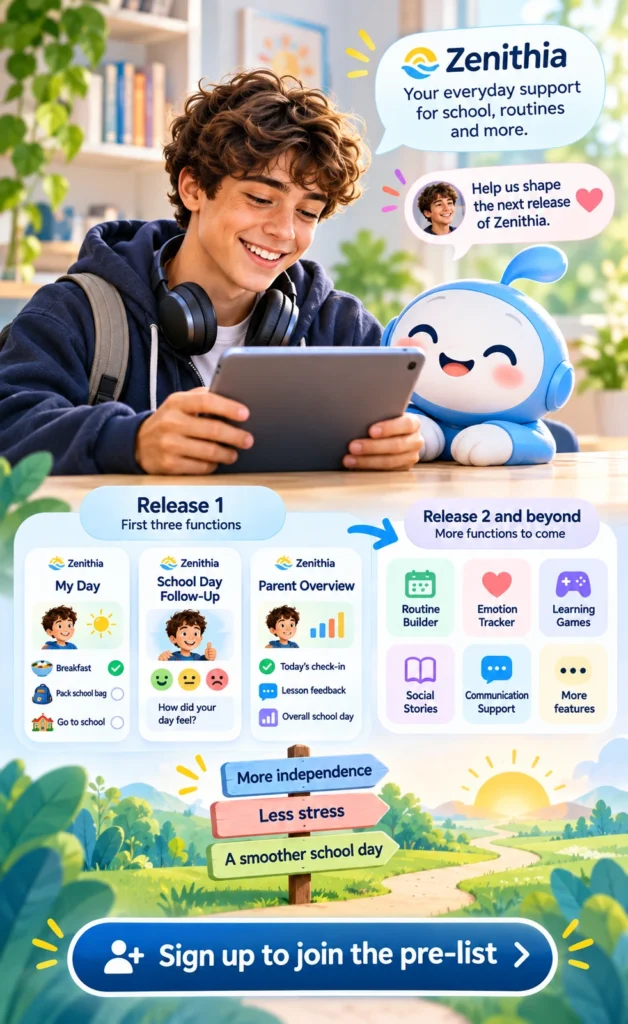
Zenithia is a mobile app built around this idea. A parent sets up the morning and school day, starting from a ready-made template, and the child or teenager follows it step by step on their own, with the plan shown as NOW, NEXT and THEN. After each lesson, the journey and lunch, they share how it went with simple visual choices, so the parent can see where the day got hard and what to ask next.
The app helps build everyday independence. It does not replace professional guidance, and it is not a medical or diagnostic tool.
One step at a time
Building independence is slow, uneven and personal. A clear plan, a predictable order and help that fades gradually give a young person the best chance to take one more step, and then another.
Zenithia’s pre-release is planned for 28 November 2026. Joining the free early access list takes about a minute, and no payment is needed today. Join the free early access list